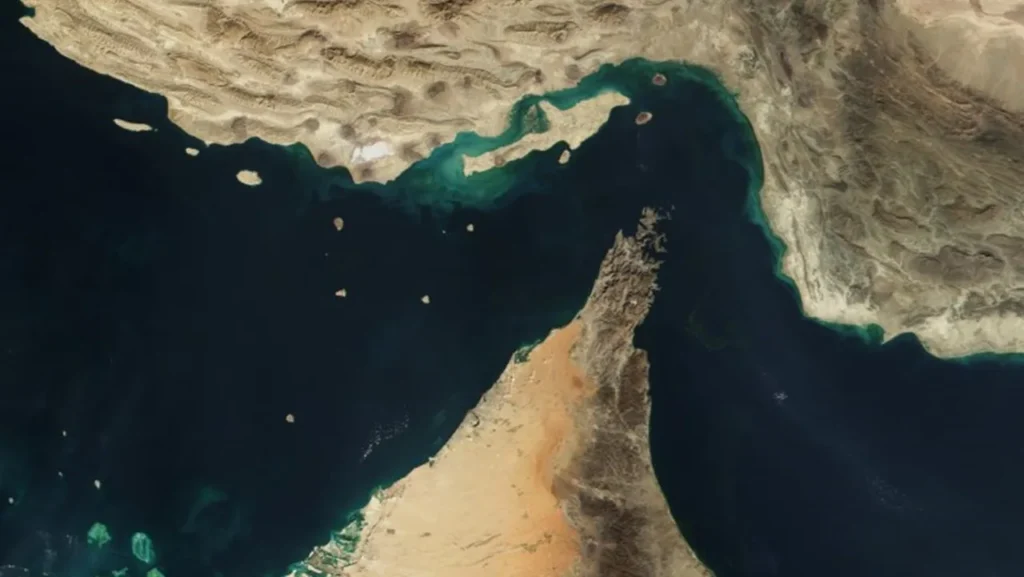
There is a particular kind of danger in a crisis that refuses to escalate into full war but also refuses to end. That is precisely where the Iran-U.S. confrontation now sits, and the Strait of Hormuz has become its pressure gauge.
According to reporting on the latest exchange of strikes, President Trump’s administration is pursuing what can only be described as a dual-track approach: economic pressure through sanctions layered atop military strikes, without a clear theory of how this combination produces an actual endpoint to the war. Iran has responded in kind, trading blows rather than backing down, and the Hormuz corridor, through which roughly a fifth of the world’s oil flows, has become the theatre where both sides signal resolve without fully committing to the wider conflagration that a genuine closure of the strait would trigger.
This matters far beyond the Persian Gulf. Every time Tehran and Washington trade strikes near Hormuz, global oil markets flinch, insurance premiums for shipping spike, and every energy-importing economy from Tokyo to Rotterdam recalculates its exposure. The strait is not just a chokepoint for Iranian oil; it is a chokepoint for Saudi, Emirati, Qatari and Kuwaiti exports too. Washington knows this, which is presumably why the strikes have been calibrated rather than decisive — enough to demonstrate resolve, not enough to force Iran into a corner where sinking a tanker or mining the strait becomes its only card left to play. But calibrated warfare has a habit of drifting. Miscalculation, not intention, is usually what turns a managed crisis into an uncontrolled one.
For India, this is not a spectator sport. New Delhi imports the overwhelming majority of its crude and a significant share of its LNG through routes that pass near or through Hormuz. Any sustained disruption there hits Indian refiners, the rupee, and inflation simultaneously — a combination no government wants heading into any electoral cycle. India also has a genuine stake in stability on both sides of this equation: it maintains a working relationship with Iran through Chabahar port and regional connectivity ambitions, even as its strategic and defence ties with Washington have deepened substantially under successive governments. That balancing act becomes harder, not easier, every time this conflict escalates. New Delhi’s muted public posture — calls for restraint, appeals to diplomacy, no clear tilt — reflects not indecision but the plain reality that India has more to lose from an oil shock than almost any other major economy, and no appetite to be dragged into picking sides in a war it did not start and cannot end.
My take: Trump’s dual-track strategy looks less like a plan and more like a hope that pressure alone will eventually produce Iranian capitulation. History suggests otherwise — sanctions and strikes have squeezed Tehran for decades without breaking its resolve, and cornered regimes tend to gamble rather than surrender. Washington should worry less about looking tough near Hormuz and more about what happens the day someone, on either side, miscalculates. For India and the rest of the oil-importing world, the only rational position is loud, persistent pressure for de-escalation, because nobody wins if that strait actually closes.
RP analysis · Based on reporting: Iran, U.S. trade strikes as Hormuz crisis deepens